Hybrid working has fundamentally changed the demands placed on office space. Companies today face the challenge of planning their workspaces efficiently and optimising costs, whilst at the same time creating an attractive working environment for staff – and this is precisely where measuring office utilisation comes into play.
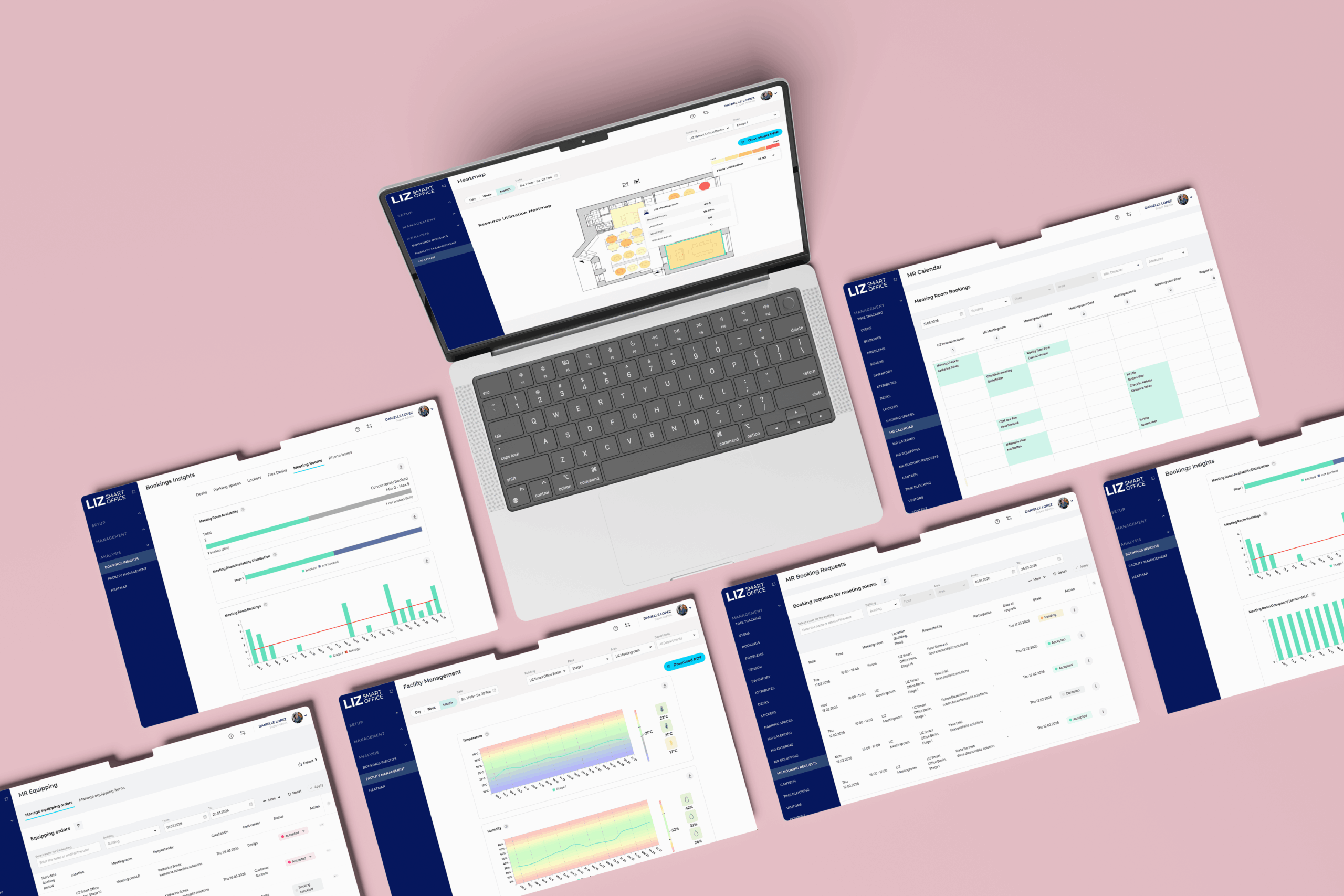
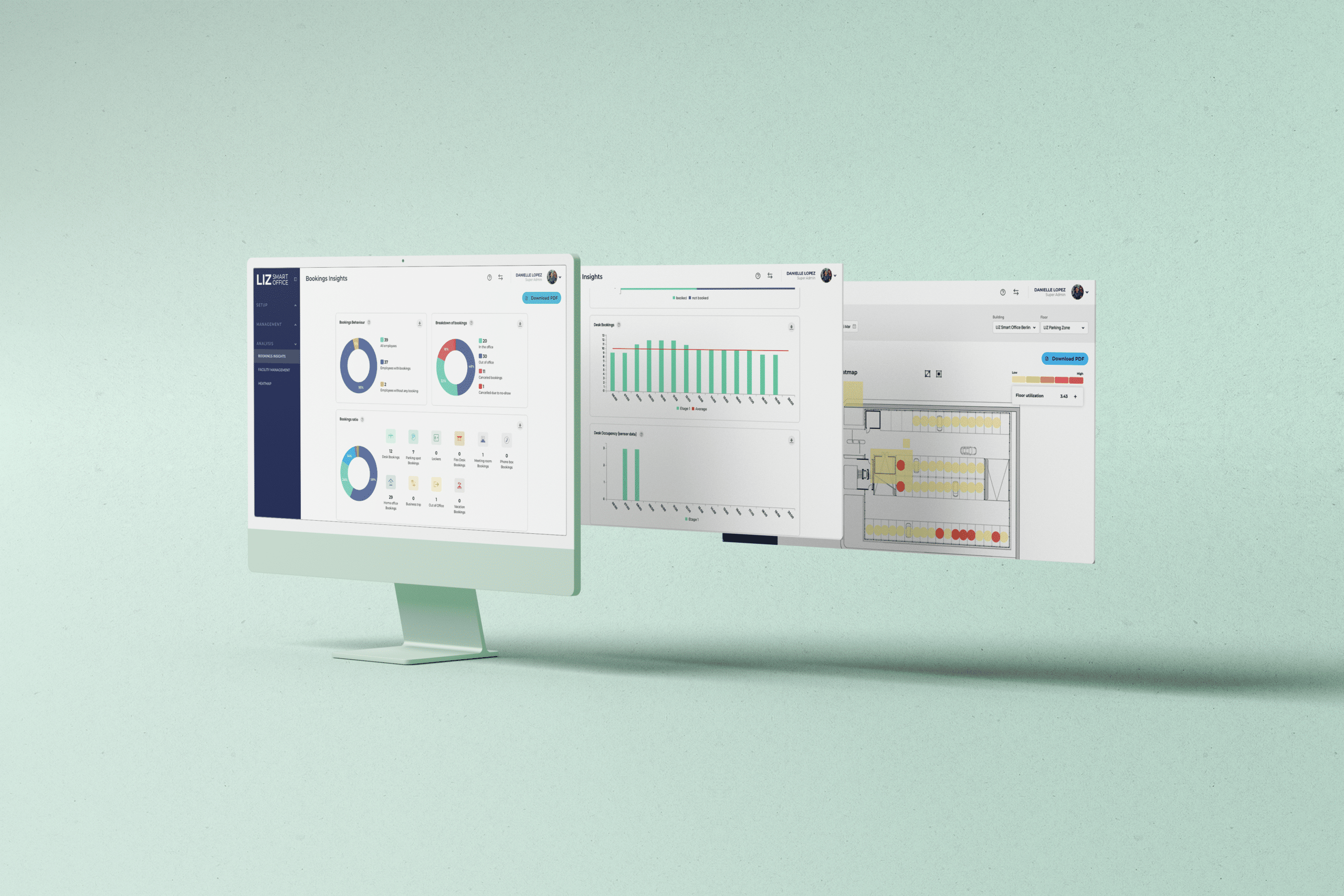
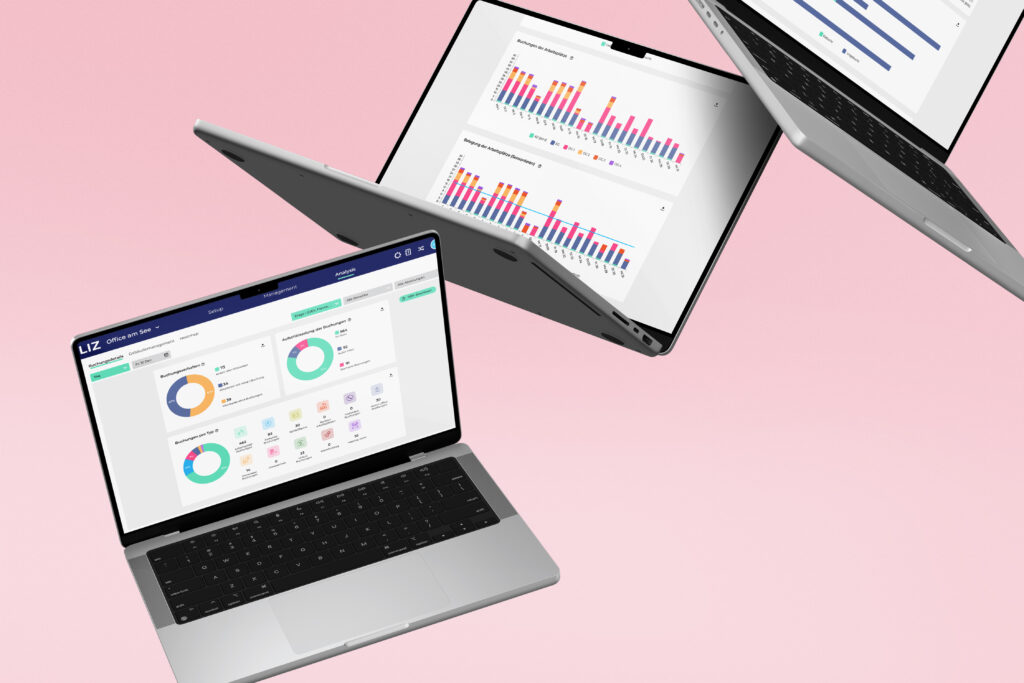
By understanding the right key performance indicators and analysing them on an ongoing basis, organisations can make better use of space, reduce vacancy rates and make data-driven decisions. Modern workplace management solutions such as LIZ Smart Office help companies to manage office space intelligently and evaluate utilisation rates transparently.
Why measuring office utilisation is becoming increasingly important
The traditional one-to-one allocation of staff to fixed workstations is becoming increasingly less important. According to a recent CBRE study, the average office occupancy rate worldwide now stands at 53 per cent. In 2024, it was just 38 per cent.
At the same time, many companies state that they are aiming for a target occupancy rate of more than
65%. Diese Differenz zeigt deutlich: Viele Büroflächen werden noch immer ineffizient genutzt.
Furthermore, the study study reveals that 69 per cent of companies already organise more than 40 per cent of their workstations using a desk-sharing model.
The result is that companies need robust KPIs to balance space requirements, the supply of workstations and actual usage.
The key KPIs for measuring office utilisation
1. Occupancy Rate
The occupancy rate describes the actual utilisation of a workstation or space over a specific period.
Formula:
Occupancy rate = occupied workstations ÷ available workstations × 100
Example:
Of 200 available workstations, an average of 120 are occupied.
Occupancy rate = 60 per cent
This KPI forms the basis of any space analysis. It enables companies to quickly identify:
- Which areas are regularly overloaded
- Where long-term vacancies arise
- To what extent hybrid working models influence space utilisation
According to CBRE the average peak occupancy rate on particularly busy days now stands at 80 per cent.
This shows that whilst some days are almost fully utilised, on other days large sections of office space remain unused.
2. Peak Occupancy
Peak occupancy measures the maximum utilisation during peak times.
This metric is particularly important for:
- Workplace planning
- Meeting room management
- Safety requirements
- Capacity limits
Particularly in hybrid working models, there are often significant fluctuations between individual days of the week. Many companies observe particularly high attendance levels on Tuesdays and Wednesdays.
CBRE reports that global peak occupancy had already reached an average of 64 per cent by 2024. In the EMEA region, it rose to as high as 81 per cent.
3. Desk-Sharing Ratio
The desk-sharing ratio indicates how many employees share a workstation.
Formula:
Number of employees ÷ Number of workstations
Example:
300 employees use 180 workstations.
Desk-sharing ratio = 1.67
A higher ratio enables significant cost savings, but also carries risks if planning is poor.
Real-world examples show that companies can significantly reduce their office space through smart desk-sharing schemes. According to a case study, a company in Stuttgart saved around 72,000 euros per year in rent and operating costs through desk sharing and hybrid working.
4. Meeting room utilisation
It is not just workstations but also meeting rooms that should be analysed.
Key performance indicators include:
- Booking rate
- Actual usage
- No-show rate
- Average meeting duration
Many companies struggle with so-called ‘ghost bookings’. Rooms are reserved but not used.
Hybrid working models, in particular, are significantly increasing the demand for collaboration spaces. VergeSense reports that meeting rooms and collaboration spaces are now among the most intensively used types of space.
5. Utilization Rate
The utilisation rate goes beyond mere presence and measures the actual active use of space.
The following aspects are analysed:
- How long workstations are used
- Which areas are actively used
- How long people stay in each area
According to VergeSense, there are still significant inefficiencies in many offices. Desks still account for more than half of office space, even though there is significantly greater demand for collaborative areas.
The conclusion is that companies need more data-driven space planning rather than one-size-fits-all spatial concepts.
6. Attendance rate by day of the week
One KPI that is often underestimated is the analysis of office utilisation on a day-by-day basis.
Many companies find that:
- There is high utilisation on a few days
- There is low utilisation on off-peak days
- Teams are unevenly distributed
- This results in either overcapacity or bottlenecks.
Analysing such patterns enables:
- targeted management of office days
- better team coordination
- more efficient space planning
7. Cost per workstation
A particularly important KPI for facility management and senior management is cost analysis.
Formula:
Total office costs ÷ average number of workstations in use
The following are taken into account:
- Rent
- Energy
- Cleaning
- Fittings
- Operating costs
If workstations remain permanently vacant, the cost per workstation actually in use rises significantly.
This is precisely why data-driven workplace management is becoming increasingly important.

Which data sources should companies use?
Accurate measurement of office utilisation is based on various data sources:
- Desk booking systems
- Room booking systems
- Access control systems
- Sensors
- Wi-Fi data
- Staff surveys
- Workplace analytics software
Modern solutions bring all this data together in a centralised system, enabling real-time analysis.
Why businesses should act now
The shift towards a hybrid working environment has long been a reality. According to recent analyses, 92 per cent of companies worldwide now operate using hybrid models.
At the same time, numerous studies show that many companies continue to use their office space inefficiently.
The consequences:
- unnecessary rental costs
- unused space
- frustration amongst staff
- lack of predictability
By contrast, companies that consistently measure their office utilisation achieve clear benefits:
- better space efficiency
- lower costs
- higher staff satisfaction
- data-driven decisions
- more sustainable use of resources
Conclusion: Trust as a competitive advantage
Measuring office utilisation is now far more than just a facilities management issue. It is a key component of modern workplace strategies. By continuously analysing KPIs such as occupancy rate, peak occupancy, desk-sharing ratio and meeting room utilisation, organisations can optimally adapt office space to hybrid working models. The future of the office is not based on gut feeling, but on data. With intelligent workplace management solutions such as LIZ Smart Office, organisations gain the transparency they need to manage space efficiently, reduce costs and, at the same time, create a modern working environment.